Weeknote #19 [W26.06] - Growing Cinema Next Door, chaotic sales pitches and the positive addition bias
Published on Feb 12, 2026 • 8 min read
I am very late with this weeknote. Both last week and this week have been very chaotic.
New venue and more for Cinema Next Door
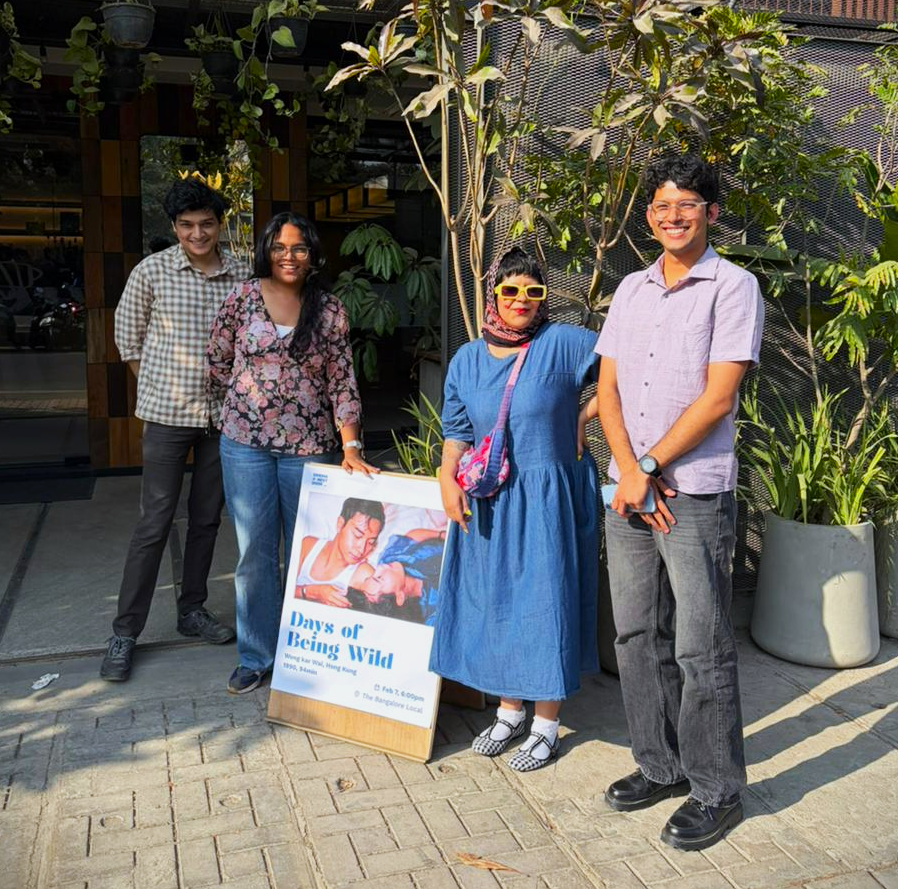
Last week, we did our first screening at The Bangalore Local.
We screened Wong Kar Wai’s Days of Being Wild. It was our biggest screening so far, with 53 people attending. Tickets sold out days in advance and we kept getting messages from people asking if more seats would open up.
I had been worried about the venue because the screening was on a semi-open terrace. I was concerned that outside light and noise would affect the viewing experience. Especially since the film heavily relies on atmosphere and immersion to really work. After the screening, however, most people said that they didn’t notice any disturbance (except for the mosquitoes).
An unexpected outcome of the event was that since I arrived very early, I made a pre-screening playlist while we were setting things up and waiting for people to arrive. I’ve been listening to it on repeat ever since.
Since I have been hosting mainly at Underline Center for the last two years (with both TPCC and CND), things have found their own rhythm there. I don’t have to think about the logistics at Underline anymore.
But hosting at a new venue forced me to make a lot of decisions which I had forgotten you have to do. Because curating involves not only picking just the films, bbut also making sure the environment and the overall experience itself is pleasant. The playlist itself actually came out from testing several sound system settings to make sure that the audio sounded right.
Upcoming collaboration with Alliance Francaise
On the day of the screening, Abhijna, Manu, and kavz also went to Alliance francaise de Bangalore to speak with their director about collaborating with them for future screenings.
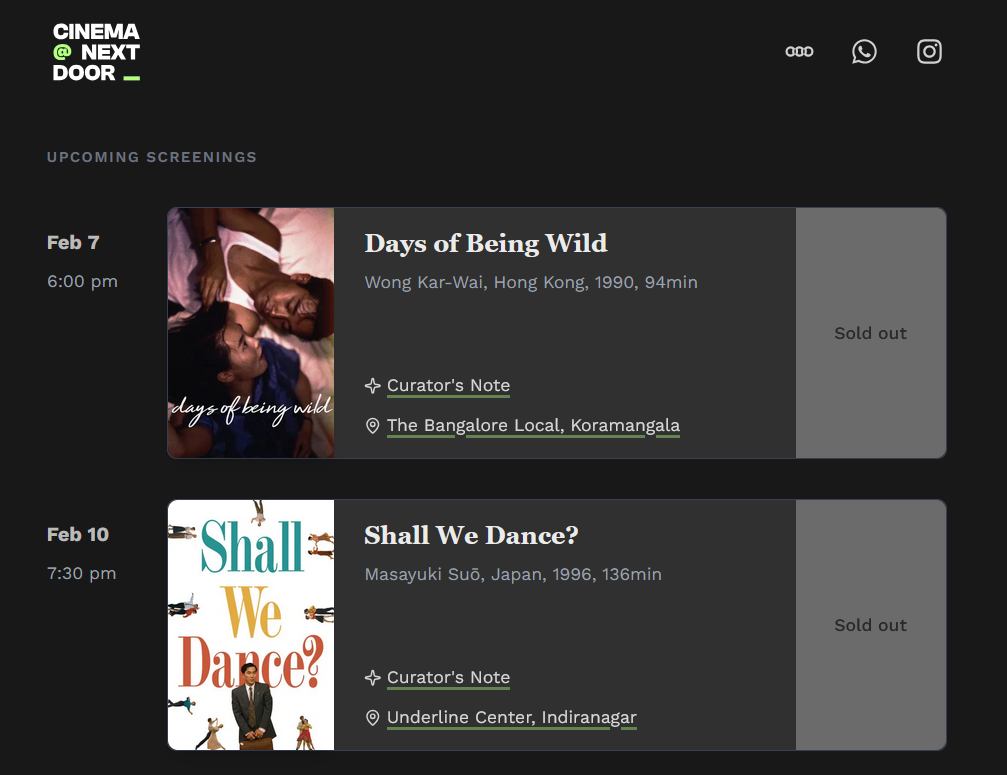
I was supposed to go as well. But the traffic on Hosur Road that day meant that it would have been impossible for me to reach on time. So I went straight to The Bangalore Local and made some small updates to the website (mainly adding a sold out sign to event listings so that less people would ask about them).
I was initially anxious about not being present for the meeting. So far, I’d been involved in pretty much all conversations related to the club and it felt weird missing out on something significant.
In hindsight, it was a nice thing to have missed it. I’ve never wanted the club to be something which is dependent on my presence (or any other individual’s for that matter). We all want it to be an actual club, a community, which can exist on its own and sustain itself.
I don’t know if we’re still anywhere near that goal yet, but this was a pretty nice reminder that we’re not doing so poorly and we’re on the right path.
The next step should be to involve more people in running the everyday operations of the club. Personally, I’m thinking it’ll be nice if I can step aside from the curatorial discussions for April and have someone else take my place. We’ll see how that goes.
Anyway, the meeting itself was successful. Alliance Francaise has screening rights for a large catalogue of French and African films and they seem willing to work with us for hosting screenings. So we may pick a few from there in the coming months (with La Haine probably being the first choice).
OKRs, reaching 2,000 followers, and saying no to people
We also recently got featured in an article on Homegrown about film clubs in Bangalore.
Their Instagram post about the article somehow reached a huge audience and it nearly doubled the number of Instagram followers on our account in a week.
When we initially set tagets, we had planned to reach 1,000 by the end of January (we ended at 997), and reach 3,000 by the end of March. At the time, those numbers had felt ambitious. But the way things are going, it looks like we were being too conservative. In fact, we are exceeding our targets on pretty much every metric we had listed.
With hindsight, I realize now that our expectations were shaped too much by our experience with TPCC. With how bad things were going there, we had — to some degree — internalized the idea that there’s not too many people interested in films or film clubs. So it’s nice to find out that assumption was entirely incorrect.
This growth and success comes with its own set of problems of course.
Tickets have been selling out very quickly. There are more people who want to attend than we can accommodate. And so we’ve been saying no to a lot of people. We’ve also been contacted by 3 additional venues interested in hosting screenings with us. For which, again, we do not really have the bandwidth.
Saying no so often feels uncomfortable. But I suppose it is a good problem to have.
Chaotic sales pitches and positive addition bias
Work has been unusually hectic because we had an important sales pitch. If the client signs, they’ll be the company’s second largest account in terms of revenue.
Although I work on the product team, I was asked to set aside everything else to work to help on the pitch.
One of my favourite things to bring up in conversations is how the English language has a positive addition bias.
What this means is that whenever there is talk of “making things better” or “improving things”, people instinctively think of adding things first.
I got to see this play out repeated while working on this sales pitch. At every meeting with the client, they would brainstorm on new ideas to add to the product. The sales team, understandably eager to secure the deal, would say yes to all of them. This meant we ended up trying to prepare a demo in one week that would normally take months to build properly.
Since building an actual product wasn’t realistic within that timeline, I suggested creating clickable Figma prototypes instead (why do I do this to myself?!) I had thought it would be manageable and also probably fun to work on something new.
What I didn’t anticipate was that Figma prototypes remove most feasibility constraints. Once I started working on it, the scope kept expanding with every internal conversation with the sales team. Add this, and add that was the usual refrain.
So I spent all of last week working on things most of which I knew would never see the light of day. Roughly 40 hours wasted working on things that will only ever appear in 10 minute demo, And honestly, I hope they stay that way, because it will be a nightmare for the development team if they ever actually had to develop some of those ideas.
I don’t really blame the sales team. They have their own targets and incentives.
The structure of the organization, however, where the incentives of the sales team so divorced from the product team’s, feels questionable. This, I also learned, has been long standing frustration product team, because a lot of priorities often shift to accommodate promises made during sales pitches.